PQ2FADS_ZU: (ARCHIVED) MPC82xx Family Application Development System  Favorite


ARCHIVED

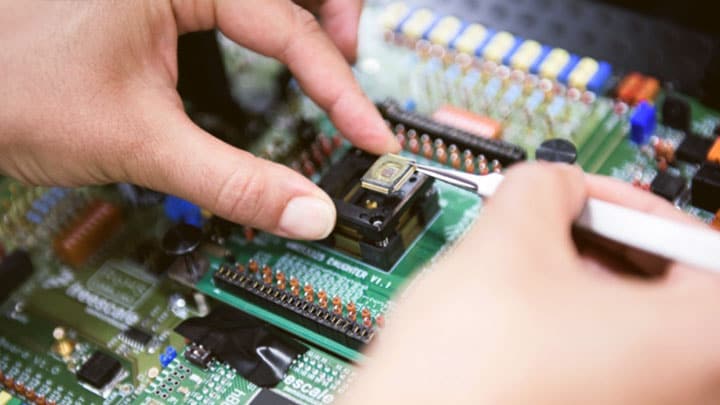
The PQ2FADS-ZU boards are designed to aid hardware and software developers of the PowerQUICC II family by providing an evaluation platform for MPC82xx derivatives in the 480-pin TBGA (ZU) package. The PQ2FADS-ZU board supports the MPC8250, MPC8260, MPC8264, MPC8265, MPC8266, MPC8270 and MPC8280.

The PQ2FADS-ZU board has 32MB of SDRAM attached to the 60x bus (soldered on board), 8MB of SDRAM for the local bus (soldered on board) and a 8MB Program Flash SIMM (supports up to 32MB). The on-board interfaces include JTAG/COP, Dual UART, USB 1.1, two 100/10-Base-T Fast Ethernets, and a 155 Mbps ATM UNI with optical interface.

Using the ADS on-board resources and an associated debugger, developers are able to download and run code, set breakpoints, display memory and registers, and connect proprietary hardware via the expansion connectors. That code can then be incorporated into a desired system with the MPC82xx processor. The PQ2FADS-ZU includes on-board resources and a debugger that allows developers to download and run code, set breakpoints, display memory registers, and display configuration registers.

Who should order this product:

Developers using any PQ2 derivative in the 480-pin TBGA (ZU) package. For PCI applications, Freescale also offers the MPC8266ADS-PCIAI as a PCI target board.

Archived content is no longer updated and is made available for historical reference only.


Features


  • Supports MPC8260 (HiP3), PQ2 (HiP4) and MPC8280 (HiP7) processors
  • 64 bit PowerQUICC II Communication Processor, running at up to 100MHz external bus frequency
  • 32 MByte Synchronous DRAM (soldered on-board), residing on 60X bus (PBI mode) with optional parity support, controlled by SDRAM machine 1.
  • 8 MByte, 80-pin Flash SIMM, buffered from 60X bus. Support for up to 32 MByte, controlled by GPCM, 5V/12V Programmable, with Automatic Flash SIMM identification, via BCSR. Support for both ON and OFF SIMM Flash reset.
  • 5V/12V VPP (in-circuit programming voltage) for Flash SIMM - jumper selectable
  • 8 KBytes E2PROM, buffered from the 60x bus, controlled by the GPCM
  • Board Control & Status Register--BCSR
  • On-board COP/JTAG connector
  • On-board logic to support direct connection to standard Parallel Port (EPP/SPP modes) in desktop PC for debug purposes using Code Warrior tools
  • Power-On Reset Option via JTAG
  • Selectable Local bus function--Local Bus SDRAM connection or PCI bus in host mode
  • 8MByte Synchronous DRAM (soldered on-board), residing on local bus with optional parity support, controlled by SDRAM machine 2
  • Programmable Power-On Reset and Hard-Reset Configuration via E2PROM or via Flash memory for the PQ2 core
  • PCI Local Bus is PCI Standard 2.2 compliant
  • 3 PCI slots are available to host up to three masters/targets cards at 3.3V only--arbitration is supported by the on-chip arbiter
  • PCI bus supports 25-66 MHz at 3.3V devices (determined by the user)
  • Simple generic Interrupt Controller to handle the PCI interrupts (four in each PCI slot)
  • Module Enable Indications for all on-board modules
  • High density (MICTOR) Logic Analyzer connectors, carrying all 60x, local bus and CPM signals, for fast logic analyzer connection
  • 155 Mbps ATM UNI on FCC1 with Optical I/F, connected to the PQ2 via UTOPIA Level 2 I/F supporting 8/16 bit in single/multi PHY, using the PMC-SIERA 5384
  • Two 100/10-Base-T Ports on FCC2 and FCC3 with T.P. I/F, MII/RMII controlled, using Davicom DM9161
  • USB Port, USB 1.1 Standard Compliant, using Philips PDIUSBP11 USB transceiver. USB Port is with shutdown option and speed selectable--BCSR controlled.
  • Dual RS232 port residing on SCC1 and SCC2
  • Module disable (i.e., low-power mode) option for all communication transceivers--BCSR controlled, enabling use of communication ports, off-board via the expansion connectors
  • Dedicated PQ2 communication ports expansion connectors for convenient tools connection, carrying necessary bus signals for transceivers' M/P I/F connection. Use is done with 2 X 128 pin DIN 41612 receptacle connectors.
  • External Tools' identification and status read capability, via BCSR
  • Separate Power-On Reset Push--Button, Soft/Hard1 Reset Push--Button and ABORT Push--Button.
  • ATX Power Supply
  • Multi-Range PQ2 internal logic operation voltage--selectable by jumper between three ranges--1.3V to 1.7V for MPC8280 (HiP7), 1.7V to 1.9V for PQ2 (HiP4) or 2.3V to 2.7V for MPC8260 (HiP3).
  • Software Option Switch provides 8 S/W options via BCSR.

Increase Your Knowledge